The Domaine’s story
A jewel of local heritage
A jewel of local heritage
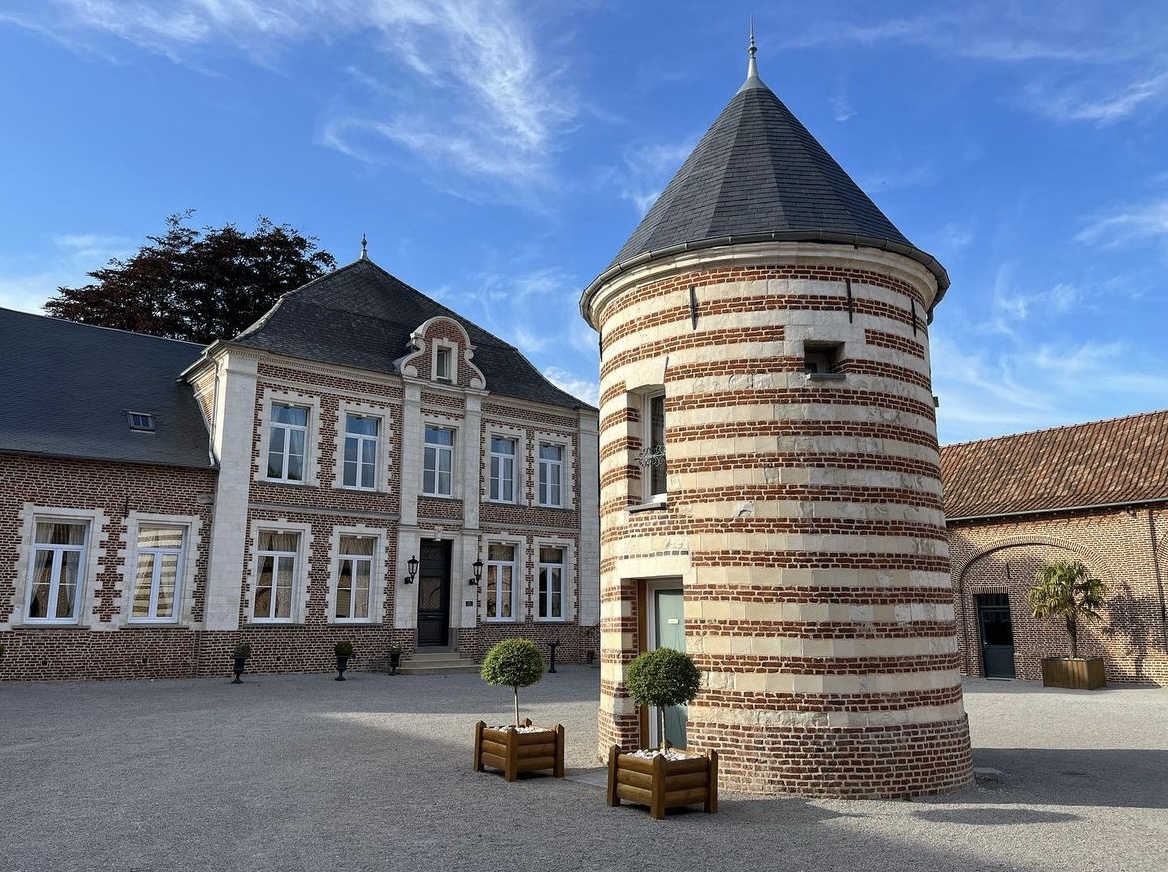
Since its creation, the building has weathered the centuries and welcomed many historical figures :Godfrey of Bouillon, Cardinal Richelieu’s daughter, and even a friend of Robespierre. When it was built in the second half of the 11th century, the Domaine was most likely a farmhouse erected on the lands of Godfrey of Bouillon. In 1569, the first official deed of ownership was issued; it mentions “Madame la Marquise Douairière de Renty,” who now lends her name to one of the Domaine’s bedrooms. Through marriages and remarriages, the Domaine passed into new hands. In 1789, the estate was estimated at 400 hectares, and its owner, the Count of Egmont, leased it to Célestin Fleury, who had the dovecote built in the courtyard.

Historic events
Historic events
The Count of Egmont and Célestin Fleury took an active part in the French Revolution. The former was a deputy of the nobility at the National Assembly, while the latter was a deputy of the Third Estate for Artois, alongside Robespierre. Their opposition during the Revolution led to the Domaine being reassigned as early as 1792, when it became the sole property of Célestin Fleury. The descendants of Célestin Fleury and Louis Lissacq, who lived on the estate, worked to restore the Domaine’s prestige by adding barns and outbuildings. In 1874, upon the death of the last Fleury descendant, the Lissacq family became the owner of the estate.
The Domaine went on through the years and once again became the setting for historic events, welcoming Belgian families in 1914 as they fled the German invasion. With the rise of agricultural industrialization, the Domaine’s architecture became too great a constraint, and the estate was gradually abandoned in favor of a modern, up-to-standard farming facility. Little by little, the place fell into a long sleep.
Bringing the Domaine back to life
Bringing the Domaine back to life
In 2009, the Braure family purchased the estate. Together, they decided to restore this historic place to its former glory. Drawing on childhood memories, Jocelyn Braure was able to recognize the site’s potential and, for example, uncover original moldings hidden behind false ceilings. With the help of local craftsmen, the barns were cleared and converted into a gîte and guest rooms, the façades were renovated, the dovecote was reinforced by a stonemason, and the floors, tiles, and doors were restored… The work lasted three years, delivering a spectacular result marked by authenticity and refined taste.
Isabelle Braure, for her part, was responsible for giving this exceptional place its purpose: a hub for connections and events with a truly rare character.